Decision velocity, not decision perfection, separates high-performing organizations from the rest.
The Speed Premium: Why Fast, Good Decisions Beat Slow, Perfect Ones
By Jason Kumpf, Strategy Advisor · September 14, 2026
Decision velocity, not decision perfection, separates high-performing organizations from the rest.
By Jason Kumpf, Strategy Advisor · September 14, 2026
Every board eventually confronts the same tension: move now with an 80 percent answer, or wait for more data and a 95 percent answer that arrives too late to matter. Research on how organizations actually make decisions gives a clear answer, and it challenges the assumption that speed and quality trade against each other.
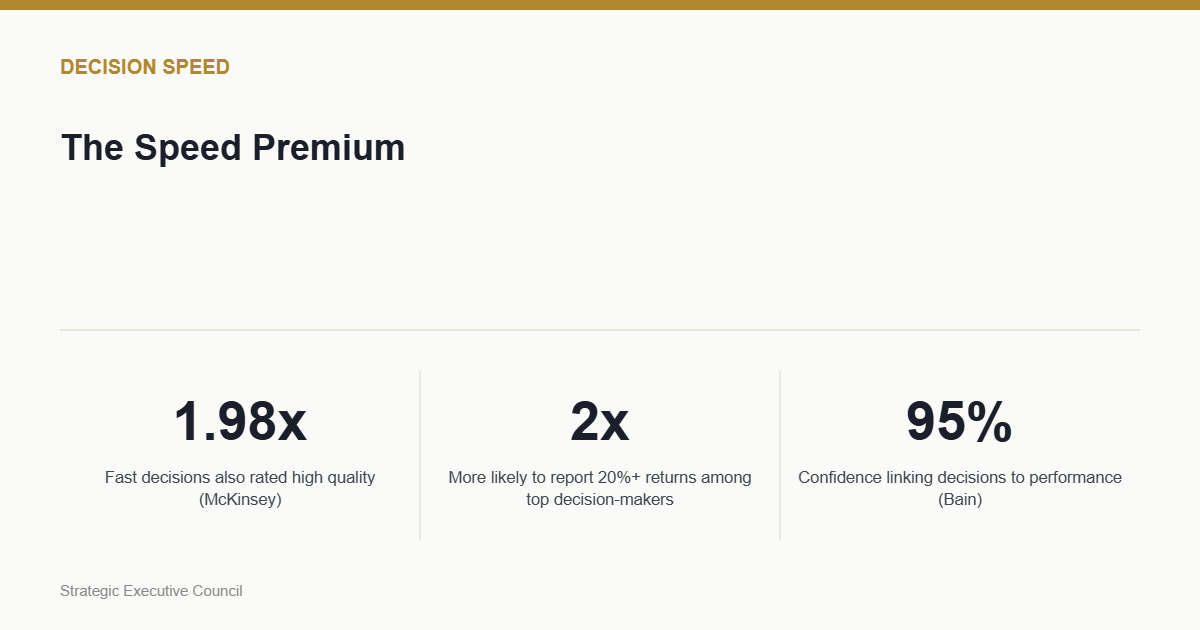
McKinsey studied how executives describe their most significant decisions and found something that runs against conventional wisdom. Respondents who described a decision as fast were 1.98 times more likely to also describe that same decision as high quality, according to McKinsey's research on organizational decision-making. Speed and quality moved together rather than apart. The organizations deciding quickly were not cutting corners. They were removing the friction that slows most decisions down: unclear ownership, too many required approvers and meetings that substitute for judgment rather than sharpen it.
The scale of that friction is larger than most executives assume. In a McKinsey survey of more than 1,200 respondents, 61 percent said most of the time their organization spends on decisions is used ineffectively, and McKinsey estimated the resulting drag costs a typical Fortune 500 company roughly 250 million dollars a year in wasted management time. That cost does not show up as a line item. It lives inside the extra review cycle, the escalation that did not need to happen and the meeting convened to relitigate a decision the organization already made.
The same research separated companies into a small group that manages to decide both well and quickly. Only 20 percent of respondents worked at organizations McKinsey classified as consistently combining high-quality and high-speed decisions. Those organizations were twice as likely to report financial returns of 20 percent or more from their most recent major decision. One in five companies is already proving that the tradeoff between fast and good is a false choice, and the rest are still operating as though it is real.
Bain reaches a similar conclusion from a different angle. Across a ten-year research program covering more than 1,000 companies, Bain found that decision effectiveness correlates with overall business performance at a minimum 95 percent confidence level. That is a strong link between an internal capability and external results, and it holds across industries and company sizes. Decision-making sits close to the center of what actually drives performance, not somewhere on the periphery of it, and it can be measured and improved with the same rigor a company applies to its financial planning.
What separates the top 20 percent is not access to better analysts or more complete information. McKinsey's research on delegated decisions found that when employees are given real authority to decide and receive active coaching from their managers, they were 3.2 times more likely to produce decisions that were both good and fast. Speed, in other words, is a product of organizational design. It comes from placing decisions with the people closest to the facts and giving them standing to act, not from asking everyone to move faster inside the same slow structure.
For boards and senior executives, the practical implication is specific and immediately usable. It starts with recognizing that most organizations apply one process to every decision, regardless of size or reversibility, and that habit is the single largest source of unnecessary delay. Sort decisions by type before deciding how much process they deserve. A small number of genuinely irreversible, high-stakes bets warrant full analysis and broad consultation. Everything else, and that is most decisions a company makes in a given quarter, benefits from a named decision owner, a short list of required inputs and a deadline treated as real rather than aspirational. Routing every choice through the same heavy process is what produces the 61 percent of wasted decision time McKinsey identified. The complexity of the decisions themselves is rarely the real constraint.
Clarity of ownership does more work than any dashboard or steering committee. When one person or a small, named group is accountable for a decision, and everyone else understands their role is to provide input rather than to approve, decisions move at the speed of judgment instead of the speed of the slowest calendar to clear. That clarity costs nothing beyond the discipline to write it down and hold to it, and it is available to any organization willing to assign it clearly.
The speed premium is not a case for moving carelessly. It is a finding, replicated across two well-established bodies of research on how large organizations operate, that good and fast are companions rather than rivals. The organizations capturing that premium have stopped waiting for a certainty that a fast-moving market was never going to provide. They have built the ownership and authority structures that let good decisions travel at the speed the moment actually requires.